How does AI impact the future?
- Jacob Levine
- Mar 25
- 5 min read

By: Jake Levine
The future of artificial intelligence seems to change by the day. When the sun rises each morning, AI has evolved more than it did the previous morning. While AI can be used as a tool to innovate, create, and learn, it’s not all sunshine and rainbows. The effects of artificial intelligence can be seen in two main facets: climate change and education. Rather than focusing narrowly on one aspect of the effects of AI, it is important to explore all avenues to uncover what it means to professionals and everyday people.
As college students, our lives may be impacted by artificial intelligence for the rest of our lives. Furthermore, as college students living in North Texas, the effects are as clear as day. AI data centers are sprouting up in this region seemingly every day, and the City of Denton is no exception. Empty fields are being bought from the city by companies such as Core Scientific, and the reasoning is simple: it’s cheap, open land that the city can profit from. While this seems to be harmless, the unseen effects are limitless.
According to the Houston Advanced Research Center (HARC), data centers in Texas use an estimated 8 billion gallons of water per year, which is something that many Americans may not even realize. In addition, the power grid that these 400+ data centers in Texas run off of consume an estimated 17 billion gallons of water. In a state that is constantly experiencing water shortages and droughts, the growth of artificial intelligence will continue to deplete the water supply for Texans. To take it a step further, HARC also reports that by 2030, data centers could use up to “2.7% of total annual water use in Texas.” This is a staggering number when considering the number of large-scale communities in the Lone Star State that rely on potable water.
Ultimately, the bright side to this situation is that companies such as Core Scientific are working to find ways to use non-potable water, leaving more for Americans to use in everyday life. The question that lurks is whether this will be able to repair the environmental damage that has already occurred, especially in dry regions such as Texas.
To continue discussing AI’s impact on the planet, it's important to consider the thoughts of everyday citizens. Statistics and research can help pave the path for understanding the impact of AI on our future, but there is a human aspect that has to be tied in as well.
We spoke with Denton residents on the town square to get their raw thoughts, without knowing anything about their background or employment. Stacy, an engineer who works with construction companies, said:
“It has the potential to do just about anything to be honest, but I don’t think that it should. We should use our own brains, our own minds. You can use it as an assistant, but I wouldn’t use it to do everything.”
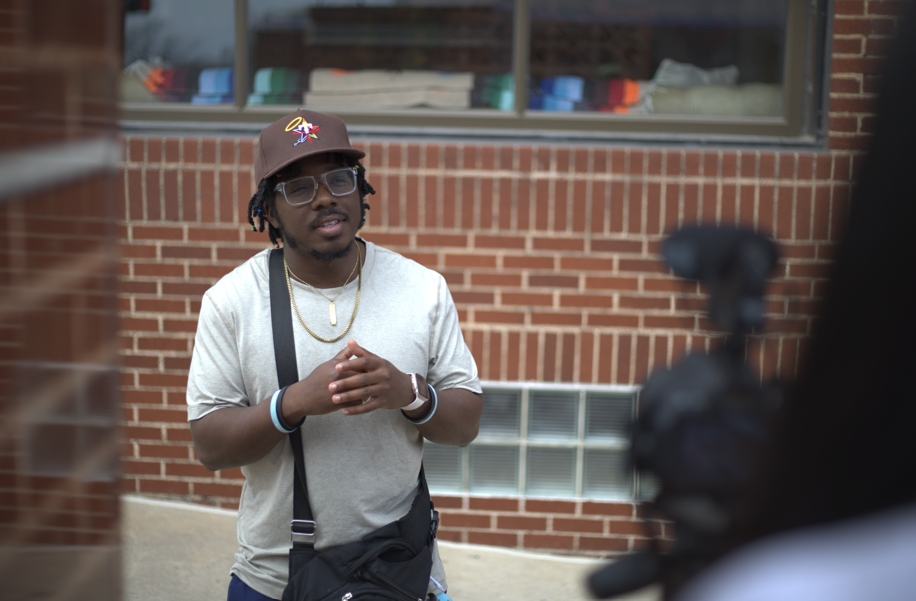
Photo courtesy of Madeline Bullie.
Stacy’s stance on the use of artificial intelligence has become common, especially amongst young people. There is a consensus growing that AI is helpful as a tool, but should not eliminate jobs and strip young people of learning. This leads us to our other major sector, which is how AI impacts education.
In education, there is somewhat of a “give and take” situation – the teacher gives, and the student takes. With artificial intelligence making its way into schools, the bond between educators and their students has weakened, and longtime teacher such as Wendy Meador are concerned for what lies ahead in the future.
“I think it takes away from building relationships, you don’t have the personal relationships that you’re creating, and especially if they’re doing the teaching.”

Photo courtesy of Jamisyn Baker.
What exactly does she mean when she says “especially if they’re doing the teaching?” Before we began recording, we discussed how there is a new private school in Fort Worth called “Alpha School” that uses AI as teachers, with human assistants available if needed. Meador, who has been teaching in Denton ISD for over two decades, was blown away by this. To the school’s credit, they boast classes ranking in the top 1% nationally. For those who are driven by analytics when grading education systems, Alpha School is a dream. However, for lifelong educators, it’s a nightmare.
Students nowadays are learning in a unique way, and for those in college, AI has become a tool that makes us question our future. We spoke with a few students enjoying coffee on the square, and Joseph Martinez had a simple message to share:
“I think it makes people dumber.”

Photo courtesy of Madeline Bullie.
While being very blunt about it, he is not necessarily wrong. After the COVID-19 shutdown, children were a few years behind in reading levels. Now, with learning being stunted by the freedom to use artificial intelligence, the upcoming classes of college students may have a more difficult time with analysis papers, open-ended projects, and hands-on experiences. Marani also shared that she “quit using AI” a few months ago because she would use it for the most simple everyday tasks, to the point where she felt like it could not be accessible to her anymore to preserve some sort of critical thinking.
At the end of the day, artificial intelligence is here to stay, whether people like it or not. There are two ways to think about it:
This is a weapon, and it is inherently bad for the Earth and its people.
This is a tool, and when used correctly, can have a positive impact on people’s lives.
The first option does not allow for positive thinking, and it only sees AI as a serious issue that can seemingly never be solved. The second option addresses the idea with an open mind, allowing people to see what good could come of it despite knowing the bad.
We dove into the environmental and educational aspects of how AI will impact the future. However, as it continues to grow, there will be endless ways to grade how it is impacting people’s lives. An article could be written every day about how AI will impact the future, and each day, the article could be unrecognizable from yesterdays. With the facts about the environment and people’s thoughts about education presented, it’s up to the reader to decide which path of thinking is right for them.
Comments